
ControleveryAIagentbeforeittakesaction.
Runtime governance for autonomous agents — observability, policy enforcement, and a decision trace you can hand to risk. Two lines to instrument. Stops a tool call before it lands.
requested —
RUNTIME IDLEActive agents
12
Policy violations
03
Blocked actions
07
Spend (UTC)
$42.81
| Agent | Health | Risk | Tool calls | Cost |
|---|---|---|---|---|
| claims.intake | healthy | 12 | 184 | $4.12 |
| underwriting.risk | watch | 41 | 96 | $11.40 |
| support.triage | healthy | 8 | 18 | $2.08 |
| kyc.verify | blocked | 78 | 14 | $0.61 |
Execution timeline
- 14:02:11model.invoke · 1.2s
- 14:02:12web.search · allowed
- 14:02:12memory.read · scope=team
- 14:02:13customer_data.export · blocked
Action blocked
customer_data.export never executed. Waiting on human approval.
Illustrative control-plane UI — not live tenant data.
Runtime story
An agent wakes up
It has a goal, a model, and tools. Nothing watches the side effects yet.
0% of the path
packet: idle · tool.call
The production reality
AI in production is a black box. When things break, you're left guessing.
Which agent made this decision?
Why did this workflow fail?
What memory influenced this response?
Why did API costs suddenly spike?
Which policy blocked this execution?
How do we audit this decision later?
Cartha sits in between.
Between your agents and production — so they're governable, predictable, and auditable.
How it works
Connect. Observe. Govern. Audit.
- 01
Connect
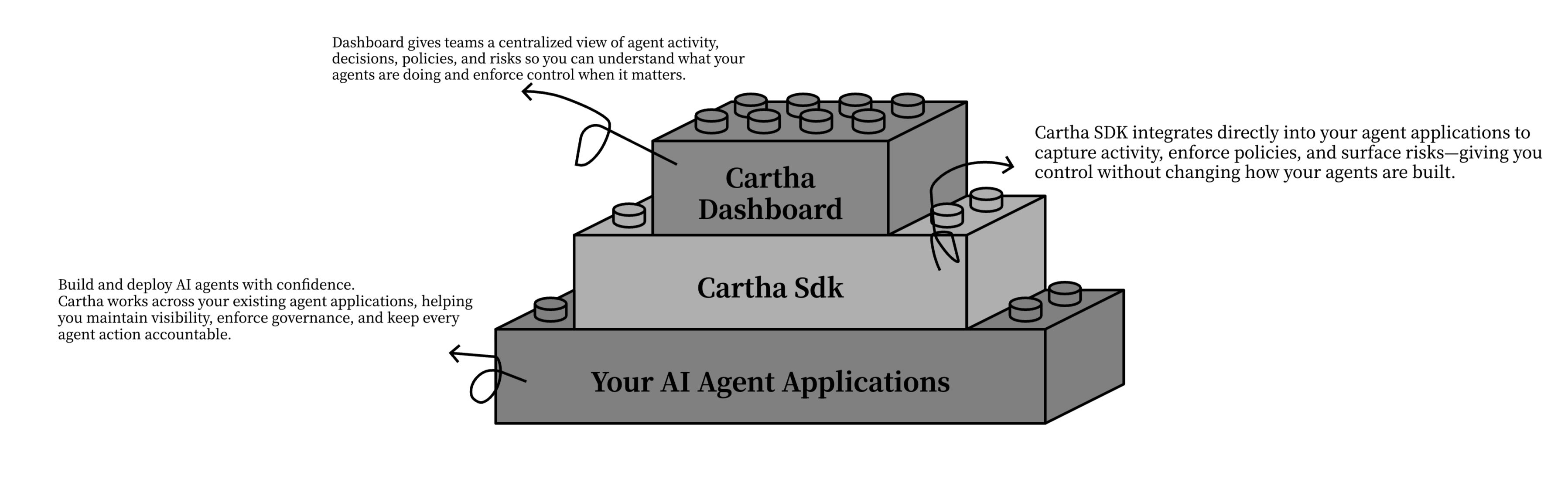
Init and instrument. Two lines against the stack you already run — LangGraph, CrewAI, OpenAI Agents, and the rest.
- 02
Observe
Every LLM call, tool, and memory access lands in one event graph. Cost, latency, and agent health without extra wrappers.
- 03
Govern
Policies, allow-lists, budgets, and human gates evaluate before the side effect. Deny is a first-class outcome.
- 04
Audit
Replay the run. Export the evidence. Show risk what the agent knew, what it attempted, and what Cartha stopped.
Control plane
Six controls. One runtime.
Observability without governance is a dashboard. Governance without a trace is a black box. Cartha is both, in the path of the call.
01 · Observability
Agent execution timeline
Every LLM call, tool, and memory read in one event graph — same schema, any framework.
- 09:42:11Agent initialized · support.triage
- 09:42:12Tool call · web.search
- 09:42:13Retrieved external data · 4 sources
- 09:42:14Policy evaluation · PII_EXPORT_RESTRICTED
- 09:42:14Risk detected · action blocked
02 · Governance
Policy engine
Evaluated before the side effect.
03 · Memory
Quad-scoped isolation
TTLs per scope. No context bleed.
04 · Cost
Attribution + breakers
Hard ceiling at 90% of envelope
05 · Decision tracing
What happened. Why. What stopped.
What the agent knew, which tools it called, which policy fired, and how it arrived at the action.
- What did it do?tool.transfer_funds requested
- Why?Prior step returned a payout instruction
- What stopped it?tool.allowlist + HITL gate
06 · Execution replay
Rewind the run
Agent state, tools, memory, and policy decisions — debug from the past, deterministically.
Accountability
When AI makes a decision, you should be able to prove what happened.
Cartha turns activity into an auditable record — what an agent did, what it accessed, which policies applied, and where a human stepped in.
Bring your AI policy or audit checklist.
We'll show where Cartha closes the gap — no jargon, a few minutes.
Zero-code setup
Two lines. Then your existing agent code.
Initialize, instrument, run. No decorators, wrappers, or manual tracing required.
- cartha.instrument() across installed frameworks
- Automatic agent, tool, and environment discovery
- Same event schema no matter the stack
import langgraph
cartha.init(api_key="…")
cartha.instrument()
# your agent, unchanged
graph = langgraph.graph.StateGraph(…)
graph.invoke(…)
The platform
Six controls. Live walkthroughs.
Runtime, audit, memory, policy, budgets, and failover — each beside a product recording.
01
Universal Runtime Model
Framework-agnostic governance. Zero-code setup for instant visibility across any agent framework with a unified event schema.
02
Governance & Auditing
Prove compliance with immutable audit logs. Track every LLM decision, tool execution, and data access retroactively.
03
Quad-Scoped Memory
Prevent context bleed. Segment agent memory across User, Team, Agent, and Org boundaries with strict TTLs.
04
Policy Guardrails
Define natural language rules. Enforce them in microseconds to block PII leaks or halt risky tool executions instantly.
05
Budget Breakers
Establish hard financial ceilings per execution. Automatically terminate runaway agent loops before budgets are exhausted.
06
Runtime Resilience
Configure automatic agent failover and trace replays to ensure high availability and deterministic debugging.
Architecture
How Cartha sits in your stack
Where it applies
Runtime control for agents that take action
If a system can call a tool, read memory, or spend tokens, it belongs on a governed path. These are the shapes of work Cartha is built for — not a customer list.
Tool-calling agents
Search, write, transfer, ticket — allow-lists and HITL before the side effect.
RAG that acts
Retrieve, then do. Trace which context influenced the next tool call.
Internal automation
Budget breakers and policy on workflows that run without a human in the loop.
Support agents
PII and export policies on customer data, with a replayable decision trail.
Research / analysis
Cost attribution per run when models and tools stack up across a long session.
Regulated workflows
Evidence for what happened — mapped to controls you already have to answer for.
Built-in, not bolted on.
Memory isolation, approvals, budgets, and replay — without assembling a custom ops stack.
Quad-scoped memory
Isolate agent contexts natively.
Human approvals
Pause execution for manual sign-off.
Budget breakers
Hard-stop agents when spend trips the cap.
Policy guardrails
Enforce rules before the tool runs.
Immutable audit trails
Every state and decision, retained.
Execution replay
Debug from the past, deterministically.
Tool allowlists
Restrict dangerous executions.
Agent failover
Reroute when an agent hits its ceiling.
Time-travel memory
Query what an agent knew at that instant.
Supported frameworks
Keep the stack you already use. We handle governance.







With and without
Security
Controls mapped. Honest about certification.
Tenant isolation, encryption, and audit logging are in the product. SOC 2 Type II and ISO 27001 are aligned — not claimed as completed audits.
Access control, immutable-style audit logging, and monitoring designed against CC-series controls.
Quad-scoped isolation and encryption in transit and at rest. Certificate when the audit is done — not before.
Your agents are becoming autonomous.
Your controls should too.
Instrument the runtime. Govern the action.